

– Sava Press Editorial –
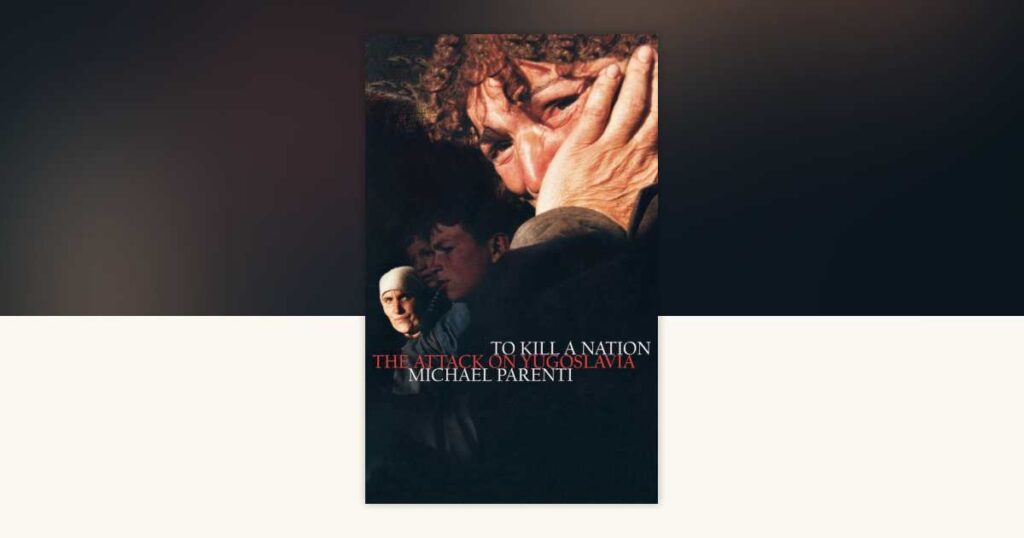
At a man’s death, especially a public-facing man who took socially controversial stands during his life, his legacy is always debated. Michael Parenti, who died on January 24, 2026, was such a man. His legacy includes interventions on some of the most pressing problems facing the world. He was undoubtedly a skilled and accomplished writer, lecturer and activist within the United States, and often in opposition to its government. If one is allured by this record, he is someone to be admired for going “against the grain,” often – as is the case in America – to his own detriment. Parts of this work often go without severe criticism. Others, however, assure that certain insistences he made during his life counter-acted this work. The crux of both interpretations, and the subject of debate regarding his life, usually centres on his position towards what was called “the Yugoslav tragedy” of the 1990s. This debate often brings out understandably emotional and hot-tempered arguments from all sides.
I do not herein seek to undertake an intervention into debates of Parenti. The truth is, debating the legacy of a man at death who was right about some and wrong about some, took some positive stands and some negative stands, but truthfully — in either case — could never fully understand the context nor unfolding of events, is not a productive activity. Especially when such activity serves as a proxy battleground for interpretations of countries’ histories, and when such problems are not so simply solved or defined by specific interpretations based on particular claims during certain periods. Оne must study an entire historical period to understand cause and consequence, interconnection and interrelation, or as historian Branko Petranović phrased it, “Thematic narrowing is the deepening of a wider phenomenon.”1
In case this thesis of mine is too dense, I merely attempt to state that Parenti did not have the authority nor experience to diagnose or treat the problems of the Balkan Peninsula – neither in that period nor any other. This is why, as I believe, he took numerous positive positions and numerous negative ones, even if a pro-con list is also not valuable in this discussion. I also reject the moral premise of the debate. Due to this, I also will not deal with problems of genocide. It is clear that what Parenti wrote stemmed from his own structural and personal beliefs regarding justice and imperialism. It is not hard to see why such a personality would take up the problem of attempting to understand why Yugoslavia – depending on one’s interpretation – “fell apart” or was “deliberately destroyed.”
In Michael Parenti’s book To Kill a Nation: The Attack on Yugoslavia, there are certain valuable positions, supported with evidence. Among the strongest and most contributive, in my view, are the undermining of Yugoslavia’s internal stability by international institutions such as the IMF, and what he calls the “Rambouillet ambush,” which is convincingly argued to be a diktat, much more severe than Austria-Hungary’s 1914 diktat to Serbia. Certain resurrections of Ustaša-style Croat nationalism during the ‘90s are also determinately argued. In my view, it is also correct in opposing the essentialist portrayal of Serbs as uniquely guilty of crimes. And, in the final sense, he makes a legitimate case against the methods utilised during the 1999 NATO intervention and bombings.
However, while determined not to undertake an intervention in the debate over Parenti’s legacy or personal morals, it remains necessary to understand why a book that is still circulated and discussed in certain circles may have limitations and, perhaps more importantly, why it came out as it did. Thus, we encounter the challenge of an historiographical, rather than moral, intervention. Such a problem still requires one to understand and evaluate the author’s views and positions.
His positions were especially weak – and I emphasise weak, as it is a problem of sources, ideology and adoption of nationalist narratives, and not morals – when dealing with the so-called “Albanian question,” the topic of this brief discussion. In this case, his analysis of the problem begins with extraordinary selective and one-sided facts from the Second World War. I present in full Parenti’s summary of the Albanian nation’s participation during the war:
“Let us begin with some history. During World War II, the Albanian fascist militia in western Kosovo expelled seventy thousand Serbs and brought about an equal number of Albanians from Albania. In northeastern Kosovo, the Nazi 21st SS division, manned by Kosovo Albanian volunteers, massacred thousands of Serbs and forced many others to flee the province. Though never much of a fighting force, the division did contribute to the Holocaust by participating in the roundup and deportation of Jews from Kosovo and Macedonia.
“Hoping to placate Albanian nationalist sentiment after the war, Yugoslav Communist leader Josip Broz Tito made Kosovo-Metohija an autonomous region and, in 1963, an autonomous province but still part of Serbia.”2
If one reads this historiographical overview of the Second World War, one might infer the Albanians were a losing or collaborative nation (that is, as opposed to state) during that war. On the contrary, the 1946 Paris Peace Conference confirmed Albania as a “winning nation” among the anti-fascist Allied coalition.3 The Albanian partisan movement was the sole local movement in Europe to liberate the country as a whole without the ground presence of a Great Power army. Historian Kristo Frashëri notes that, per capita, Albania lost the fifth most population among Allied states in the fight against fascism.4
On September 12, 1944, the Albanian partisan command ordered their 3rd and 5th Brigades to cross its pre-war borders into Kosovo (Kosova) to liberate this Albanian-majority territory belonging to Yugoslavia. This goal was largely accomplished by these two units, incorporated into the 5th Division, alongside the 1st Kosovar Division.5 The SS Skanderbeg division, which Parenti refers to and correctly states was involved in crimes, was disbanded by the German command on October 24,6 after the Albanian partisans entered Kosovo. If the SS Skanderbeg was composed of Albanians, Albanians were also a major factor in its dissolution, with the remaining German officers of this division defeated by the Albanian and Kosovar partisans in the liberation of Prizren on November 14.7 Other Albanian collaborator movements in Kosovo, such as the Balli Kombëtar, were largely defeated in battle by the Albanian and Kosovar partisans.8 These events accelerated the willingness of Kosovar Albanians to join the partisan movement. Records show that during the entirety of the war, about 50,000 fighters from Kosovo joined the regional section of the Yugoslav partisan army, the majority of whom were of Albanian nationality. In battle with the fascists, 6,203 Kosovars fell, 28 of whom were posthumously declared national heroes.9

October-November 1944
Source: Lufta Partizane Shqiptare. ‘Mësymja e UNÇSH në Kosovë’.
Parenti’s view of the Second World War, therefore, strikes as a broadly revisionist one and an attempt to categorise the Albanians as collaborators, given – implicitly or explicitly – to justify his view of subsequent events. In specific, the critical role of anti-fascist Albanians in liberating Kosovo is omitted.
Secondly, the second paragraph of the excerpt presented above makes an assertion that is based on the author’s logic but not on the historical record. Post-war, the Yugoslav communist leadership was primarily concerned with placating Serbian national consciousness by including Kosovo within Republican Serbia.10 On principle, as individuals with communist ideological views, they tended towards the view that Kosovo should be joined with Albania. Further supporting this notion is the notetakers’ record of a February 1947 meeting between a Yugoslav delegation and Stalin, where Kardelj stated on behalf of the Yugoslav leadership that they were contemplating the unification of Kosovo with Albania in the future.11
In this vein, returning to the last days of the war, another critical event is omitted by Parenti, one which must be examined to understand the mistrust the Albanians of Yugoslavia held towards their government. During December 1943-January 1944, the Kosovo and Metohija Regional Committee of the Communist Party of Yugoslavia held what has come to be known as the “Bujan Conference” in northern Albania. This conference, composed of communist Serbs and Albanians from Kosovo, resolved that “Kosova and the Dukagjin Plateau” would be united with Albania after the war, reflecting age-old aspirations for Albanian unification.12
The Kosovo Serbs present, as ideological communists, most likely signed the Bujan Resolution as a recognition of Lenin’s principle of national self-determination. It is especially interesting, therefore, that Parenti does not base his own argument on the basis of self-determination, but according to irredentist logic of “historical territories.” By ignoring Bujan, he also ignores the attempt of Balkan communists to solve the question themselves, instead treating Kosovo as an “historically integral part of Serbia,”13 while the Albanians are almost entirely presented during this period as fascist-adjacent, forgetting the role of Albanian communists.
It is not entirely clear why Tito and the CPY rejected the Bujan Resolution. The internal republican borders of Yugoslavia were not, as is often claimed, signed into law by the Second Session of the Anti-Fascist Council for the National Liberation of Yugoslavia (AVNOJ) at Jajce in 1943, but were a matter of discussion merely among the top communist leadership, namely Tito, Aleksandar Ranković, Milovan Đilas and Edvard Kardelj.14 The secretive personal nature of these talks makes understanding their rationale exceptionally difficult. It is worth noting that post-war, communist leader Moša Pijade declared that the borders of Yugoslavia were “natural.”15 This is obviously not the case, as such a conference present in the history of Yugoslav communism proves that – at least in the case of Kosovo – borders were a matter of human debate and decision-making, not laws of nature.
If the Albanian partisans’ entrance brought about optimism for Kosovo Albanians, their post-liberation inclusion into the Yugoslav state was seen as coercive by a significant segment of the population. Among other events which led to the Albanian distrust of Yugoslavia include well-documented moments in historical literature such as the Bar (Tivar) Massacre of Kosovo Albanian partisans,16 the inclusion of Vaso Čubrilović in Tito’s post-war cabinet and the relative continuation of his pre-war royal plans for Kosovo Albanian deportations to Turkey through displacement,17 the ‘40s-‘60s ban on the Albanian flag and secondary educational instruction in the Albanian language,18 and the police and army violence of 1982.19 It is worth asking why Parenti does not discuss these events, while a single SS Division of Albanian nationality is centred, in the context of their unquestionable crimes.
The truth is that all peoples living on the Balkan Peninsula had varying forms of national collaborators during the Second World War. Besides the Croatian, Muslim, Albanian, Macedonian, Bulgarian, Greek and Slovenian collaborators, there also existed Dimitrije Ljotić’s Serbian Volunteer Corps (Ljotićevci) of the Waffen-SS, the militia of the Zbor Serbian fascist movement. This group incorporated nearly 10,000 fighters,20 while the SS Skanderbeg incorporated 6,000-6,500 fighters,21 though this comparative view is only helpful in this context, and not as an evaluative methodology. It is neither productive nor positive to centre Second World War collaborators of certain nations for aims of painting a specific picture of later events. It is, rather, characteristic of an implicitly essentialist view which can only discredit serious scholarship.
This essentialism Parenti spares the Serbs but saves for the Albanians brings him, at times, to conclusions that make him seem rather unfamiliar with the topic he is discussing. One example is the following statement: “KLA [Kosovo Liberation Army] fighters saluted with a clenched fist to the forehead, uncomfortably reminiscent of the 21st SS division and fascist militia of World War II.”22 Again, the SS Skanderbeg is invoked, but this time in a way that does not withstand basic historical scrutiny. There is no evidence that this SS division or any “fascist militia of World War II” utilised the salute he describes. Rather, the raised fist to forehead salute was that of the Albanian anti-fascist partisans and later communist Albania, from which the KLA adopted it as a symbol. This factual error is a result of Parenti’s inability or unwillingness to deal with Albanian history – a limitation present throughout the book.
One aspect which Parenti does not even attempt to understand amidst all these events is the stand of the People’s Socialist Republic of Albania during its existence. It is rather odd that, while dealing with the problem of the Albanians, he did not investigate this question, given both the importance of Albanian statehood to Albanian national consciousness, as well as his inclination towards states of a communist orientation.
Post-Cold War research has uncovered numerous very revealing documents from this period, placing the question of Kosovo within the international situation. Most interesting among them is a letter from Enver Hoxha, then General Secretary of the Party of Labour of Albania, dated no later than September 2, 1949, to the Communist Party of the Soviet Union (Bolsheviks) regarding the status of Kosovo.23 Hoxha contends – after laying out his interpretation of Yugoslav-Albanian relations regarding Kosovo during the war – that the Albanian question must be made a central tenet of ideological Cominformism, and that in predicted armed uprisings against the “Tito clique,” Kosovo must be detached from Yugoslavia and joined to Albania.24
Drawing on Russian archival transcripts of a conversation with Hoxha on March 23, 1949, Stalin mentioned the oppression of “Muslims” in Yugoslavia.25 And in November 1949, according to Enver Hoxha’s memoirs, Stalin responded verbally to his September letter, and agreed that in the future, Kosovo should determine its own future,26 although no archival record has yet been found of this conversation. In his aforementioned February 1947 discussion with a Yugoslav delegation, Stalin is quoted as responding to Kardelj’s position in favour of Kosovo-Albanian unification: “Very good – that’s the right approach.”27
The propaganda of the entire socialist camp, as part and parcel of the international anti-Titoist informational line of that time, can be seen as strongly supportive of the Albanians in Yugoslavia, within the broader strategic aim of undermining the Yugoslav government. This was a common topic of discussion in the Cominform’s official organ, For a Lasting Peace, For a People’s Democracy!, especially in articles such as “The Tito-Rankovic Gestapo,”28 “Tito Clique – Rabid Enemy of the Albanian People,”29 “Tito Clique Foments Nationalist Hatred”30 and “Criminal Intrigues of Tito-Rankovic Fascist Clique Against Albanian People.”31
After the Soviet-Albanian split, a similar informational line remained in place in communist Albania for decades. The PSR of Albania consistently attempted to shift world opinion in favour of the Albanians in Yugoslavia, especially after the events of 1981-82.32
I recall all these moments to substantiate the position that the pro-Serb view of the ‘90s, expressed by Parenti regarding the Albanians, should not be seen as “campism” for the Eastern, Soviet, Communist or Russian world, as it is often miscategorised. A fracture among these forces across space and time, according to political rule and aims, prohibits a monolithic “campism” on this question.
If Parenti’s analysis is not “campist” in nature, then what is it? Perhaps the most revealing attestation is his reproduction of the following 1987 sensationalist report from New York Times journalist David Binder on Kosovo: “Slavic Orthodox churches have been attacked, and flags have been torn down. Wells have been poisoned and crops burned. Slavic boys have been knifed, and some young ethnic Albanians have been told by their elders to rape Serbian girls.”33 He comments on this account, calling it “an early untutored moment of truth.”34 Despite this certainty, he was undoubtedly unable to confirm such general and inflammatory claims. Throughout Parenti’s treatment of the “Albanian problem,” mental imagery of defiled Christian churches are repeatedly invoked, the Albanians are depicted as unruly and violent, and the Albanian leaders are consistently painted one-sidedly as fascists and terrorists, while the Serbian leaders are presented as rational and civilised. In the latter case, he tends towards a journalistic style with the appearance of justifying certain actions by Serbian forces, typical of “imperialist” press techniques he is criticising. Parenti’s view demonstrates a tendency towards Serbian national consciousness within a specific epoch, and especially in dealing with Serbian-Albanian relations, regardless of his view towards “imperialism” as a global structure.
In this instance, Parenti’s analysis may be less anti-Western than it first appears. It may be better to categorise his logic itself not outside but within a Western understanding – a stand-in for an older Western logic emphasising geopolitics in relation to civilisational hierarchy, in opposition to the newer, post-war Western logic of democracy and human rights. His insistence on the “historical claims” of the Serbs over “Kosovo and Metohija,” unquestioning acceptance of sensationalist reports, as well as his refusal to engage with Albanian sources, is comparable with the logic used by Western powers in attempting to undermine Ottoman strength during the prior century. Or, put in another way, Parenti continues a Western epistemologic tradition of essentialising the Balkan Peninsula – only, in this case, in such a way opposed to the dominant narratives of his own society. Thus, his method may be different, but his framework still engenders the very fractures he opposed, and does so through a remarkably Orientalist narrative of religious conflict. Is it not a better service to Serbs, Albanians and others to present them as concrete socio-historical forces in constant motion and fluidity?
This proposition, and the omission of critical historical facts, prompts a thorough questioning of the posthumous framing of Michael Parenti’s work on Yugoslavia. Rather than examining it through a moral lens, one may view it as an historical artefact whose author could not understand these historical developments, largely due to capability, ideology and position. His selective viewpoint also sets his outlook for the book, and to some extent, explains why he takes the controversial positions he does. Parenti thus produced a work which could be rationalised from his own standpoint during the period in which he wrote it, and in that way it may have accomplished its goal, but only through “thematic narrowing” to exclude historical analysis of years prior.
Notes
1 Petranović, Branko. Istoričar i savremena epoha. Novinsko-izdavačka ustanova ‘Vojska’, 1994, p. 19.
2 Parenti, Michael. To Kill a Nation: The Attack on Yugoslavia. Verso, 2002, pp. 95-96.
3 This was confirmed in the 1947 Treaty of Peace with Italy, where Albania received a $5,000,000 reparation and, according to Article 88, alongside accession earned the designation of “Associated Power.” (Union of Soviet Socialist Republics et al., ‘Treaty of Peace with Italy’, United Nations Treaty Series (Paris) 49, no. 747 (1947), pp. 126, 155, 168, 170.)
4 Frashëri, Kristo. The History of Albania (A Brief Survey). N.p., 1964, p. 325.
5 Lufta Partizane Shqiptare. ‘Mësymja e UNÇSH në Kosovë’. Accessed 25 January 2026.https://www.luftapartizane.com/faza-iii/mësymja-në-kosovë.
6 Tomasevich, Jozo. War and Revolution in Yugoslavia, 1941-1945: Occupation and Collaboration. Stanford University Press, 2002, p. 154.
7 Lufta Partizane Shqiptare. ‘Mësymja e UNÇSH në Kosovë’.
8 Lufta Partizane Shqiptare. ‘Mësymja e UNÇSH në Kosovë’.
9 Alban Dobruna, ‘Albanians of Kosovo in the National Liberation Anti-Fascist War during World War II (1941-1945)’, Historijski pogledi 8, no. 13 (2025), p. 198.
10 Besides the post-war prioritisation of Serbian national aims towards Kosovo, Tito is quoted in Albanian literature during 1946 official talks with Enver Hoxha as stating: “Kosovo and the other Albanian regions belong to Albania and we shall return them to you, but not now because the Great Serb reaction would not accept such a thing.” (Miranda Vickers, The Albanians: A Modern History (I.B.Tauris, 2011), p. 165).
11 Girenko, Iu. S. Stalin-Tito. Izdatel’stvo politicheskoi literatury, 1991, p. 309.
12 Elsie, Robert, trans. ‘1944: The Resolution of Bujan’. Texts and Documents of Albanian History. http://www.albanianhistory.net/1944_Resolution-of-Bujan/.
13 Parenti, To Kill a Nation, p. 109.
14 Čavoški, Kosta. ‘The Formation of Borders and the Serbian Question’. In The Creation and Changes of the Internal Borders of Yugoslavia, edited by Stanoje Ivanović, translated by Spomenka Ninčić-Šoć. The Ministry of Information of the Republic of Serbia, 1994, p. 34.
15 Čavoški, ‘The Formation of Borders and the Serbian Question’, p. 33.
16 See: Robert Elsie, ‘Kosovo and the Bar Tragedy of March 1945’, Südost-Forschungen, no. 71 (2012): 390-400.
17 See: Vaso Čubrilović, ‘The Expulsion of the Albanians: Memorandum Presented on March 7, 1937 in Belgrade’, trans. Robert Elsie, Texts and Documents of Albanian History, 1937, http://albanianhistory.net/1937_Cubrilovic/index.html; and Sabit Syla, ‘Displacements of Albanians to Turkey, According to Diplomatic Documents of Albanian Government’, Anglisticum Journal 5, no. 10 (2016): 13-18.
18 See: Michele Lee, ‘Kosovo Between Yugoslavia and Albania’, New Left Review (London) 1, no. 140 (1983), p. 86.
19 See: Pajazit Nushi, ‘The Phenomenon of Military-Police Violence in Kosova in the Years 1981–1992’, Kumtesa, Instituti i Historisë ‘Ali Hadri’ Kosovë, 28 July 2025, 147–54.
20 Tomasevich, War and Revolution in Yugoslavia, p. 194.
21 Kane, Robert. ‘Skanderbeg SS Division’. In War in the Balkans: An Encyclopedic History from the Fall of the Ottoman Empire to the Breakup of Yugoslavia, edited by Richard Hall. Bloomsbury Publishing USA, 2014, p. 287.
22 Parenti, To Kill a Nation, p. 100.
23 Minxhozi, Ymer, ed. Letër e panjohur e Enver Hoxhës mbi Kosovën: dokumenta të Arkivave Ruse. Botimpex, 2002, pp. 9-27.
24 Minxhozi, Letër e panjohur e Enver Hoxhës mbi Kosovën, pp. 22-23.
25 Minxhozi, Letër e panjohur e Enver Hoxhës mbi Kosovën, p. 58.
26 Hoxha, Enver. With Stalin. The ‘8 Nëntori’ Publishing House, 1979, p. 142.
27 Girenko, Stalin-Tito, pp. 309-310.
28 Peter Gabor, ‘The Tito-Rankovic Gestapo’, For a Lasting Peace, for a People’s Democracy!, 14 July 1950, 28 (88).
29 Liri Belishova, ‘Tito Clique – Rabid Enemy of the Albanian People’, For a Lasting Peace, for a People’s Democracy!, 18 May 1951, 20 (132).
30 Andor Berei, ‘Tito Clique Foments Nationalist Hatred’, For a Lasting Peace, for a People’s Democracy!, 25 May 1951, 21 (133).
31 Mehmet Shehu, ‘Criminal Intrigues of Tito-Rankovic Fascist Clique Against Albanian People’, For a Lasting Peace, for a People’s Democracy!, 23 November 1951, 47 (159).
32 English-language attempts can be seen, for example, in: About the Events in Kosova: Articles from “Zëri i popullit” and Other Press Organs. The ‘8 Nëntori’ Publishing House, 1981.
33 Parenti, To Kill a Nation, p. 96.
34 Parenti, To Kill a Nation, p. 97.